So, you’ve got a tenant improvement project. An 8,000 square foot interior buildout. The lease date is in 90 days. The buildout hasn’t even begun yet.
What can kill your schedule isn’t the work itself, but the time spent waiting between trades. The demo crew finishes up on Thursday, but the framer doesn’t show up until Monday. The drywall crew waits around for a week because the framer didn’t close out their punch list. And the painters roll in before the drywall finisher has.
All those days you’re waiting around, you’re never getting back.
At Venado Partners, we do demolition, framing, drywall, and paint work, as well as masonry and small dirt and utilities work, all on one contract. This gives us the ability to control the sequence. We don’t have to wait for a phone call from someone else to bring the next trade in. We know when the previous scope is completed because we’re the ones that did it.
The Sequence That Drives Your Schedule
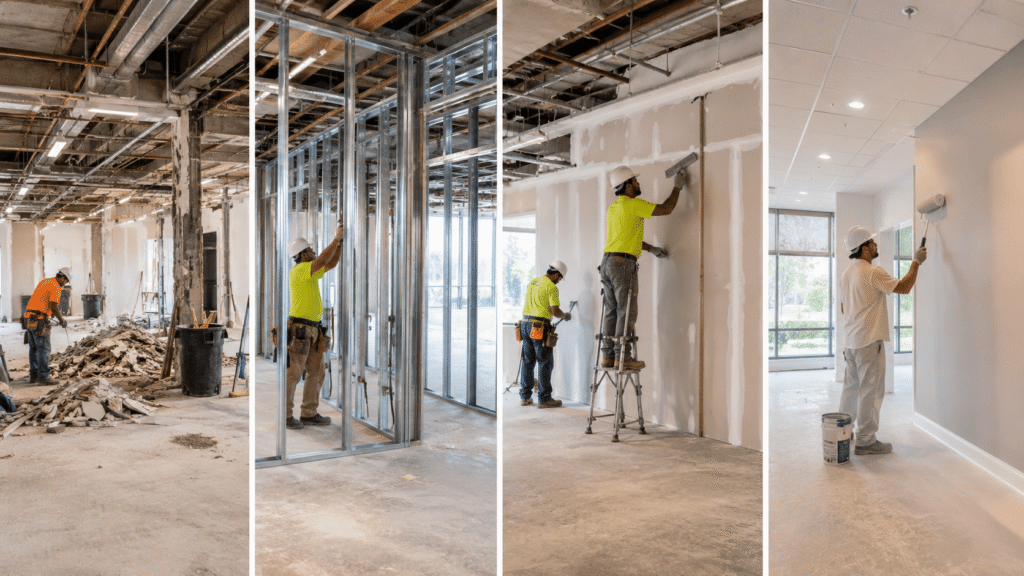
Interior buildouts go through a similar flow. If a step is skipped, compressed too much, or handed off to different subcontractors, everything breaks down. Here’s how the sequence looks when one company performs the work:
Demolition — Demolition involves stripping the space to its structure, removing old partitions, flooring, ceilings, and MEP stub-outs. Leaving a blank slate behind. When done correctly, demolition typically takes 2-5 days for a standard 5,000-10,000 SF interior space. If done incorrectly, such as with incomplete demolition, unaddressed abatement issues, or leftover debris on-site, it’ll delay the following trades.
Framing — Framing establishes new walls, soffits, and ceilings according to the plans. Metal stud framing creates the boundaries of the space prior to other work. If the framing isn’t done correctly, it’ll affect the drywall and the finish work will exacerbate any errors.
Drywall — Hanging, taping, floating, and finishing of the drywall. Depending on the level of finish required, the work could be at levels 1 through 5. Drywall is usually the first place to see schedule compression in a buildout. Rushing the mud work can lead to callbacks down the line. A well-sequenced drywall phase will allow for appropriate drying times without slowing down the rest of the project.
Paint — Painting primers and finish coats. Painting is typically the fastest work to complete, but only if the surface is ready to be painted. Problems like bubbling, peeling, and touch-ups can always be traced back to improperly finished or dried drywall.
These four phases make up 80% of the interior buildout. Four scopes. One handoff, or four handoffs, depending on how the project is contracted.
The Downside of Using Multiple Subs for One Buildout
If you contract each phase separately, you’re responsible for coordinating four different subcontractors, four different schedules, four different sets of paperwork, and four different chances for delays. Every time a phase is turned over, there’s potential for error:
The demo crew is early but doesn’t tell anyone. The framing crew doesn’t realize they have space available. Two days lost.
The framing crew falls behind. The drywall crew has another job scheduled and pushes your project back by a week.
The drywall finisher finishes the job but leaves punch items. The painter starts. Now you’re doing the touch-up after the final walk-through. These aren’t made-up scenarios. They’re what happens on a TI project with multiple subs every single day. And while each gap is only a few hours here and there, it adds up to two weeks missing from a 90-day project.
How bundling changes the equation
Venado’s approach is straightforward. We take the scopes we’re capable of delivering — demolition, framing, drywall, paint, masonry, and small dirt and utilities — and we self-perform them in sequence. Here’s the result:
No delays between handoffs. Your framing crew knows when demo ends. There’s no phone tag, no waiting around for someone else to clear the way.
One point of contact. No more chasing two subs to figure out who dropped the ball when drywall gets delayed.
Faster mobilization. We don’t have to coordinate four different mobilizations. We mobilize once and run the sequence.
Tighter punch list. When one team does framing, drywall, and paint, punch items are addressed immediately rather than popping up later as callbacks.
Real-world example
Take a typical 10,000 SF office TI project with the following scope: selective demolition of existing partitions, metal stud framing for private offices and conference rooms, drywall hung and finished to Level 4, and a two-coat paint system throughout.
With four separate subs and clean handoffs, this takes about 4–5 weeks from demo to final paint — if there are no delays.
If Venado handles all four scopes on one contract, we’ll have it done in 3 weeks or less. Not because we do any single scope faster, but because we’re eliminating the gaps between them.
That’s a week saved on one floor. Imagine that across a multi-tenant building where three suites are being turned over at the same time. The numbers are starting to add up.
When bundling works — and when it doesn’t
There are certain types of projects where we can deliver true value by bundling scopes: tenant improvements, suite turnarounds, capital improvement projects where the majority of the scope involves demo through paint.
We offer three levels of engagement:
Specialty Sub: You need a drywall sub or a paint sub. We come in, do our job, and leave.
Super Sub: We handle multiple scopes under one contract. This is where sequencing really pays off. Demo, framing, drywall, and paint, or demo, framing, drywall, paint, and small dirt and masonry.
Small GC: We manage the full project on smaller builds, providing GC-level oversight without the GC-level price tag.
If you’re working on a project that requires structural steel, MEP work, or specialty finishes outside of our scope, we’re not the best fit for those scopes. We won’t try to sell you services we can’t deliver. Our scope is focused and intentional. And that’s why we’re able to do what we do so well.
Owner-Operator Accountability: The Person Who Bids Is the Person Who Builds
Something that isn’t on the Gantt chart but impacts every phase: accountability.
If you hire Venado, the same person who walked your space during the bid will manage the work and be responsible for the punch list.
That matters for sequencing because the person who bids understands the flow — how long it’ll take to demo on this square footage, where the framing gets tricky, how many days we need for a specific level of drywall finish. The estimate reflects reality because the estimator is the builder.
There is no layered project management structure. There is no phone tree of subcontractors. There is just one price, one phone number, one contract for the scopes that comprise the majority of your interior buildout.
Ready to Compress Your Next Buildout?
If you’re looking at a TI, suite turnover, or interior buildout in Texas, reach out to Venado Partners before you sign contracts with four different subcontractors. We’ll tour the space, scope the project, and show you how one contract covering demo, framing, drywall, and paint can reduce weeks off your schedule — not by doing less, but by doing fewer handoffs.
Contact us at VenadoPartners.com. One call. Multiple scopes. Done right.
FAQ
What scopes does Venado Partners provide for interior buildouts? Demo, framing, drywall, paint, masonry, and small dirt and utilities. Those six scopes account for roughly 80% of an average interior buildout. We don’t do structural steel, MEP, or any specialty trades outside of those six scopes.
How much schedule time does bundling scopes actually save? It depends on the project, but if you remove the delay between demo, framing, drywall, and paint, you usually save a week to two weeks on a standard 10,000 SF interior TI. The schedule time saved comes from removing idle time between trades, not from completing each scope faster.
What sizes of projects does Venado Partners handle? Three: Specialty Sub: single scope work starting at $25K+; Super Sub: multi-scope work starting at $150K-$2M; Small GC: full project management starting at $100K-$3M. We’ll advise which model works best for your project scope and budget.
Does Venado Partners work outside of Texas? No. Venado Partners focuses on the Texas commercial construction market. Our team, supply chain, and accountability model are designed to serve Texas projects well, not to spread ourselves across other states.
How is Venado different from hiring a general contractor? A general contractor hires multiple subcontractors and charges overhead for coordinating them. Venado combines the scopes we directly complete — demo, framing, drywall, paint, masonry, small dirt and utilities — under a single contract with owner-operator accountability. You get GC-level coordination for the scopes that represent the lion’s share of your buildout, without paying GC-level overhead for scopes we don’t complete.