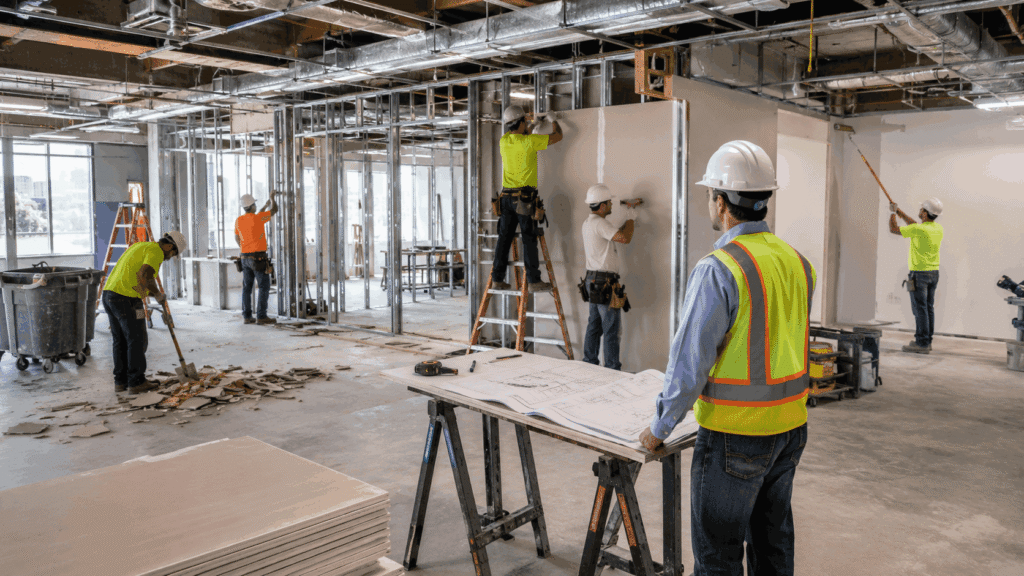
You’re putting together a 12,000-square-foot office TI. Demo, framing, drywall, and paint. Four scopes. Four contracts. Four insurance packets. Four phone calls when a timeline changes.
Or, you make one phone call, sign one contract, and give 80% of the buildout to a single responsible party.
This is the choice many GCs, developers, and property managers are making today. Here’s how to evaluate it.
What Specialty Subs Do Well
A specialty sub specializes in one scope. Drywall. Paint. Masonry. They know their trade inside and out, have the staff to do it, and, on the right project, can deliver the most efficient path to completion.
Specialty subs excel when:
- You require deep expertise in one particular scope, such as decorative masonry or high-performance drywall.
- The project is big enough to warrant a dedicated crew for each scope.
- You have a project manager who can coordinate four or five different subs, each with their own schedule, mobilization plan, and punch list.
- Scope boundaries are well-defined, with minimal overlap and few or no ambiguities in how one sub’s work interfaces with another’s.
If that sounds like your project, using a specialty sub for each scope may be the way to go.
How Super Subs Change the Game
A Super Sub covers multiple scopes under one contract. At Venado, that means demo, framing, drywall, paint, masonry, and small dirt and utilities. This work accounts for approximately 80% of a typical office buildout and is completed by a single vetted group with one point of contact.
This is how the Super Sub approach impacts the project:
One Schedule Instead of Four
If demo runs late, framing doesn’t have to sit around waiting for a call to reschedule. The same people who demoed the space are already lined up to frame it next. The sequence remains intact, and there are fewer gaps between trades.
One Contract, One Insurance Packet
One main contract. One COI. One set of prequalification documents. If you’re managing six or seven subs on a buildout, eliminating three of them from the coordination list saves time on paperwork and all the related phone calls.
One Person to Call When Things Go Wrong
If there’s a question about who is responsible for fixing something between framing and drywall, no one points fingers at another sub. It’s the same people, the same contract, and the same person who prepared the bid, walks the job, and manages the punch list.
How to Decide: Four Questions to Ask Before You Bid
Before breaking down a project into individual scopes or handing it off to a multi-scope partner, ask yourself the following:
How Many Scopes Overlap?
If your buildout includes demo, framing, drywall, and paint, those trades support each other. Combining them means less handoff time. If you’re looking at a single scope, such as masonry repointing on a facade, a specialty sub is more straightforward.
How Much Time Does Your PM Have?
Each additional sub means another schedule to manage, another RFQ to respond to, and another relationship to nurture. If your superintendent’s plate is full, combining scopes saves time.
How Big Is the Project?
For a $75K suite turnover, a single multi-scope partner is often sufficient. For a $5M ground-up project, you’ll likely want dedicated subs for individual scopes. Venado’s sweet spot is $150K to $750K. For smaller scopes of $25K or more, consider a specialty sub.
How Soon Do You Need to Mobilize?
One vetted team mobilizing together beats coordinating four separate crews. If you’re facing a compressed timeline, which is common with TI work, that speed is worth money.
What Does Venado Actually Do?
Venado offers three levels of engagement to match your project:
- Specialty Sub: Single-scope work. Need drywall hung, paint rolled, or a demo package cleared out? One trade, one contract, one job.
- Super Sub: Multiple scopes bundled into one contract. Demo through paint, framing, masonry, and small dirt and utilities. One team, one schedule, and one responsible party.
- Small GC: Venado acts as the primary contractor for the entire project, overseeing the build, coordinating the different scopes, and delivering the finished product.
The person bidding your project will also be the person walking the site. There’s no second layer of management. There’s no PM who has never met the crew. The bidder, the builder, and the person standing behind the punch list are the same person.
The True Cost Comparison
Most GCs find that when they break down the cost by line item, the comparison looks like this:
A large GC includes costs for project managers, estimators, back-office staff, marketing, and other overhead. All of these costs get built into the bid. They provide coordination capacity, but if 80% of a TI buildout consists of demo, framing, drywall, and paint, you may be paying for services you don’t need.
Venado is built differently. There’s no second layer of management and no inflated general conditions. A flexible crew model, using prequalified independent contractors who scale up and down by project, means you pay for capacity when you need it and not when you don’t.
The cost efficiency of a sub. The accountability of a GC. The responsiveness of an owner-operator.
When to Make the Call
If your next project includes two or more of the following scopes, demolition, framing, drywall, paint, masonry, or small dirt and utilities, and you’re managing them with separate subs, you’re probably spending too much time and money.
One call. Multiple scopes. Done right. This isn’t a slogan. It’s a better way to run the job.
Contact VenadoPartners.com to discuss your upcoming project. We’ll let you know right away whether the Super Sub model is suitable or whether a single-scope specialty sub is a better fit.
Frequently Asked Questions
What’s the Difference Between a Specialty Sub and a Super Sub?
A specialty sub performs one trade, such as drywall. A Super Sub bundles several trades under one contract. Demolition, framing, drywall, paint, masonry, and small dirt and utilities are covered by one team, one schedule, and one point of accountability.
When Should I Consider Using a Super Sub vs. Individual Subs?
Consider a Super Sub when your project requires two or more overlapping scopes, such as demo, framing, drywall, and paint on a TI buildout, and you want to compress the schedule.
The Super Sub model is best suited for projects between $150K and $2M where bundling scopes reduces handoffs and lowers the level of coordination required.
Does Venado Accept Scopes Beyond Its Six Core Trades?
No. Demolition, framing, drywall, paint, masonry, and small dirt and utilities are Venado’s core trades. If your project includes MEP, HVAC, or structural steel, separate vendors will handle those scopes. However, Venado can coordinate with them through its Small GC offering.
Who Runs the Project if We Use Venado as a Super Sub?
The GC or project owner oversees the overall project. Venado manages its bundled scopes within the contract, including sequencing, labor, and quality control. The GC continues to manage the overall project schedule and site coordination.
How Quickly Can Venado Get Started?
Because Venado performs multiple scopes with one crew, there is only one mobilization instead of several start dates for different trades.
For most jobs, Venado can provide a proposal within 24 to 48 hours after walking the site and begin work shortly after the contract is executed.