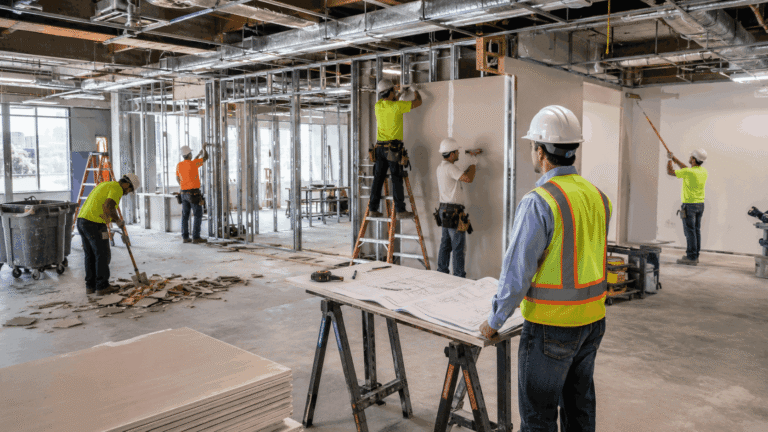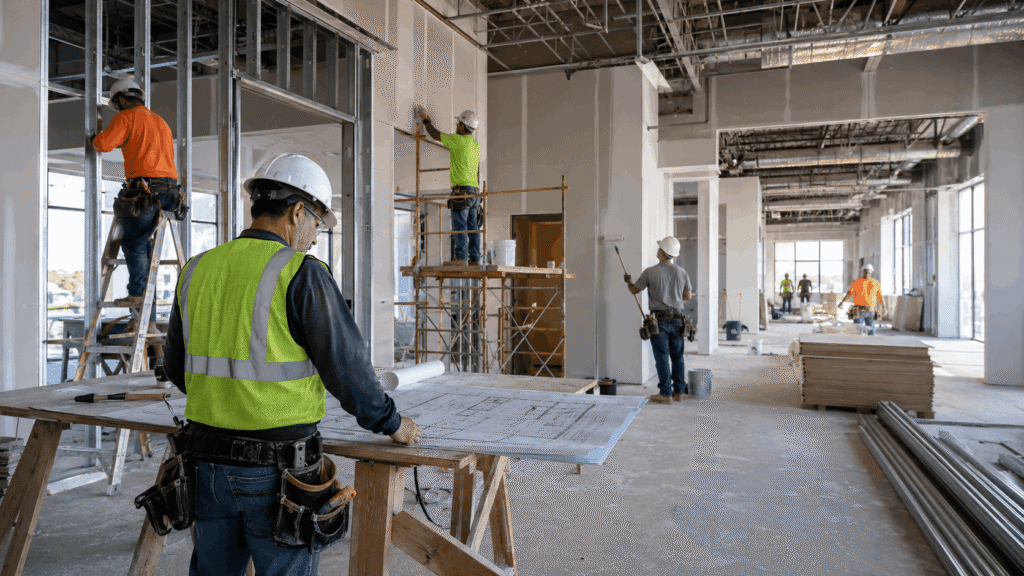
If you’re a general contractor, developer or property manager in Texas today, you know the drill. Project backlogs are swelling, skilled labor is hard to find, material prices keep edging upward and project owners are calling, asking, “Can you do this sooner?”
Yes, you can. But you won’t do it by building the way you’ve always built.
Commercial construction in Texas is booming in 2026, but not all markets are equal, and the winners in this environment will be those who own their schedule and keep their costs down. Here’s what’s happening, and what it means for the next phase of your Texas project.
The Market: Growth, Backlog and Bidding Pressure
Texas is the #1 state for commercial construction spending, with more than $50B in annual construction volume. By comparison, the next-closest state, Florida, only has about half that volume. According to the Federal Reserve, U.S. economic growth is projected to reach 2.2% in 2026. And over the last couple of years, construction has outpaced GDP growth, creating nearly twice as many construction jobs as the rest of the economy. In fact, specialty trade contractors in nonresidential construction have added around 95,000 jobs since August 2024.
And commercial construction backlogs are on the rise. As of the middle of 2026, 51% of construction firms reported that backlog increased, compared to 40% in April. Texas is in the South region, which has the nation’s longest pipeline at about nine months. So, you might think this is great news for us. And it is. But what it also means is your subcontractors have more to juggle and less flexibility.
The Problem: A Skills Gap and More Coordination Risk
Now here’s the part that hurts. Fully 52% of construction contractors report that the biggest challenge they face in 2026 is the skills and worker gap, up from 48% at the start of the year. In Texas specifically, 92% of firms report that they have a hard time finding qualified workers. Nationally, 349,000 new workers need to be hired to keep up with projected demand in 2026.
On the job site, this could mean your drywall sub gets called to another job and doesn’t show up for two extra days. It could mean your demo company hasn’t hired enough people and you’re stuck waiting for them to mobilize. It could mean your drywall sub finishes work across town, leaving your painters to wait three extra days before starting their job.
The difference between those trades is a difference in your project timeline. If you’re coordinating six different subcontractors — demo, framing, drywall, painting, masonry, and small dirt and utilities — you’re managing six different levels of coordination risk. Six chances for things to go wrong. Six times someone has to call and apologize when things fall apart.
The Venado Approach: One Contract, Six Trades, One Phone Call
This is where Venado Partners comes in. Our Super Sub + Small GC hybrid model combines six trades — drywall, painting, demolition, masonry, framing, and small dirt and utilities — into one contract. That’s roughly 80% of an average interior buildout, and you’ll have a vetted point of contact for all of it.
Why this matters in a competitive labor market:
- One less coordination handoff. When the same team is doing demo through paint, there are no schedule gaps between trades. There’s no waiting on Sub B to finish before Sub C can start. The sequence just flows.
- Faster mobilization. One crew model. One mobilization plan. We scale up or down per project with pre-qualified independent contractors — no cost inflation, no quality issues.
- Owner-operator accountability. The person bidding the job is the person walking the site, and standing behind the punch list. There’s no project manager in the office reading a report. The bidder is in the field.
- Sub-level pricing, GC-level accountability. You get the pricing of a sub without the GC markup. And you get GC-level coordination because the scopes are already packaged together.
What This Means for Different Stakeholders
For General Contractors You need a sub you can slot into a schedule and trust to deliver. Venado’s three engagement models — Specialty Sub ($25K–$150K), Super Sub ($150K–$750K), and Small GC ($100K–$2M) — give you the ability to scale the relationship to the project. A 5,000-square-foot suite turnover doesn’t need six separate contracts. A $500K TI buildout doesn’t need three levels of GC overhead. Pick the right model for the scope and go.
For Developers and Building Owners Commercial construction in Texas costs anywhere between $190 and $340 per square foot in 2025–2026. Every coordination inefficiency shows up in your pro forma. Material costs have increased 2.6% year-over-year. Labor scarcity has caused premiums to rise. The companies controlling costs are the ones reducing coordination overhead — not the ones adding more layers to manage it. One contract for six scopes means fewer change orders, fewer schedule delays, and fewer invoices to reconcile.
For Property Managers Suite turnovers are about speed and reliability. When a tenant leaves, the clock starts ticking. Every day of delay is a day of lost revenue. Venado’s bundled model means one phone call, one crew, one responsible party — from demo through paint. No calling three subs to coordinate a 2,000-square-foot suite turnover. No passing the blame when the punch list is due.
Why This Model Works in Texas Right Now
Texas construction spending is not decreasing. Population growth, data centers, industrial relocation, and infrastructure projects are accelerating demand. But the shortage of skilled labor — the number-one bottleneck in the market — is not shrinking quickly enough. The U.S. construction industry needs 349,000 new workers, and Texas contractors say finding qualified tradespeople is nearly impossible.
Which means two things. First, the subs you rely on will get busier, and more difficult to book. Second, the cost of coordination breakdown — missed transitions, schedule delays, rework — will continue to increase. The companies that can protect their margins going forward are the ones that reduce the amount of moving parts on any given project. Venado was founded to serve this exact marketplace. It’s not that the concept of bundling is a particularly smart sales pitch; it’s that there is a tangible need to solve an issue of having too many trades, too few skilled workers, and too much potential for delay if something gets out of sync.
What to Do Next
If you’re considering a TI buildout, a suite conversion, or a capital improvement project in Texas, I suggest asking yourself a simple question: How many subs will be needed to perform the demo, carpentry, drywall, painting, block work, and minor earthmoving for your project?
Now, how many coordination touchpoints will there be? If the answer is higher than necessary, you’re exposing your project to avoidable schedule delays and indirect costs.
One phone call. Six different scopes. Perfect execution. It isn’t just a slogan. It’s a system created for a time when timely completion, responsibility, and cost management are the difference between winning and losing a project.
For more information on Venado Partners and how our Super Sub + Small GC concept operates, please visit VenadoPartners.com. Born by the Trades. Operated Like a General Contractor.
Frequently Asked Questions
Which scopes are covered by Venado Partners? Drywall, painting, demolition, block, carpentry, and earthmoving and utilities are the six primary areas that Venado covers. These comprise roughly 80% of an average tenant improvement. The company exclusively handles projects that fall into these six categories.
What project sizes does Venado support? We offer three distinct service levels: Specialty Subcontractor for projects ranging from $25,000 to $150,000; Super Subcontractor for projects from $150,000 to $750,000; and Small General Contractor for projects from $100,000 to $3,000,000. Our system adapts to your needs, so you won’t pay GC fees on a small project or lack resources on a large project.
How does Venado mitigate labor shortages? We utilize a pool of vetted independent workers that can be scaled as the project demands. Since we bundle several trades under one contract, we can manage the entire sequence — demo to paint — without the scheduling delays that occur when multiple subcontractors are involved.
What is owner-operator accountability? It means the individual who prices the job is also the one walking the jobsite and answering to the client at the end of the day. There’s no middle management to filter communication and no disconnect between who quotes the work and who executes it.
Is Venado Partners a general contractor or a subcontractor? Both. Depending on the job, we can serve as a single-trade specialist, a multi-trade Super Sub, or a Small GC. This approach allows you to receive the pricing advantages of a specialized sub and the oversight of a general contractor, while avoiding the inflated overhead associated with traditional large-scale GCs.