
Let’s say you have a $400,000 TI project. You could give it to a big GC who will add in layers of project management, administrative costs, and contingency. Or you could give it to a small sub who will be great at their scope, but leave you to manage four other trades.
Both solutions aren’t right for the middle market. That’s what Venado exists to address, and this is where the difference is most apparent in terms of pricing.
The Overhead Issue With Large GCs
It’s not that large general contractors charge more because their drywall is better. It’s because they have to. This is what the money is spent on for most GC-managed TI projects:
Layered project management. A senior PM, project engineer, superintendent, and assistant, and they all bill against your project, even if the work doesn’t require that level of staff.
Home office costs. A portion of every invoice pays for corporate overhead, marketing costs, and administrative support that has nothing to do with your buildout.
Contingency stacking. Contingency is already baked into a GC’s base bid, but there’s a second contingency added for subbed scopes. You’re essentially paying for risk twice.
Subcontractor markups. When a GC is breaking out drywall, paint, demo, and framing as separate subcontractors, each sub has its own mobilization costs, minimum charges, and markups. Plus, the GC is taking their percentage on top.
By the time the invoice gets to you, 15–25% of the total isn’t going toward materials or labor. It’s going toward the machine around it.
How Venado’s Pricing Is Different
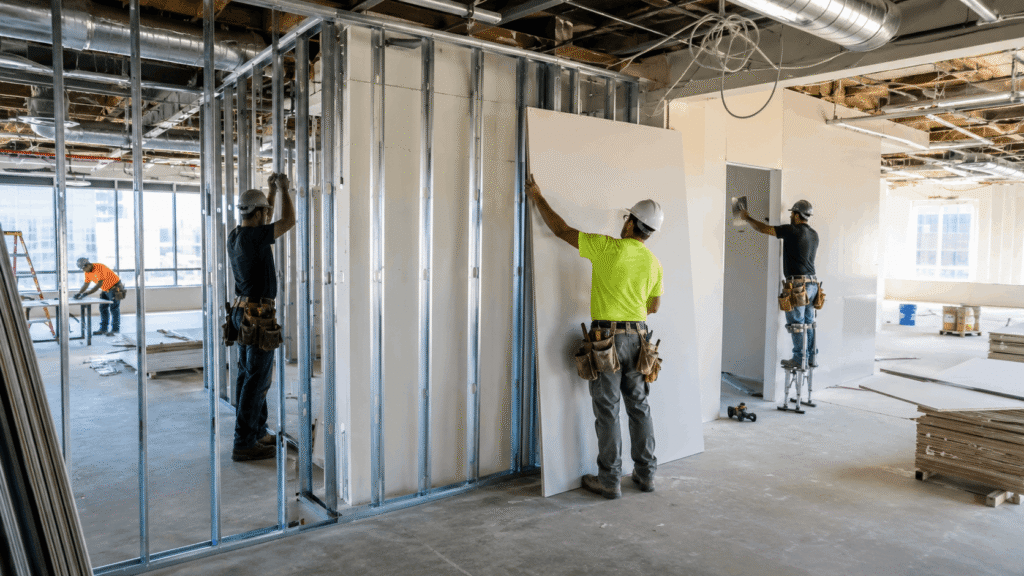
Venado uses a Super Sub + Small GC model. We self-perform the scopes we’re best at: drywall, paint, demo, masonry, framing, and small dirt and utilities. We price those items ourselves. There are no subcontractor markup layers. There are no extra project management tiers.
This looks like this:
One contract, not five. If Venado is doing demo, framing, drywall, and paint, there’s only one contract. You’re not paying five different mobilization costs. You’re not managing five different subcontracts. You’re not coordinating five different project schedules.
Owner-operator pricing. The person that bids your project is the same person who walks the job site and stands behind the punch list. So the bid is accurate. It’s not an estimate generated by someone who hasn’t visited the space.
Scaled project management. On a $300K buildout, you don’t need a four-person PM team. You need one point of contact who is responsible, who knows the scopes, who knows the schedule, and answers the phone. That’s what Venado does.
Flexible crew model. Venado uses pre-qualified independent contractors that grow or shrink based on the needs of your project. You’re not paying for idle crew time built into an inflated baseline. You’re paying for labor that your project actually needs.
Three engagement tiers, three different price points. Venado doesn’t have one price. Venado has three, based on scope size:
Specialty Sub. For single-scope work: drywall package, paint job, demolition. Simple pricing for simple scope. No GC overhead, since you aren’t buying GC services.
Super Sub. Multiple scopes under one contract. Here’s where things get really interesting: less mobilization cost, one set of crews, one person calling the shots.
Small GC. For projects that require GC services, but aren’t big enough to require Big GC pricing. Venado does the scheduling, manages the trades, and completes the buildout without all the Big GC fluff.
I’m not saying Big GCs aren’t right for every situation. They’re perfect for massive projects where dozens of trades are working together on a single site. But if your project is mostly a buildout, including demo, framing, drywall, and paint, there’s no reason you should be paying for a system designed to coordinate a skyscraper.
What the Numbers Look Like
Let’s consider a real example: a 12,000 sq ft office tenant improvement project. Demolition of existing finishes, metal stud framing for new partition walls, drywall hang and finish, paint.
Traditional GC approach: 4 separate subs, each with their own mobilization fees and minimum charges, marked up by the GC’s general conditions rate (12-18%). Cost of doing business includes at least four handoffs, each one introducing risk of conflict, confusion, or dispute over who owns which part of the scope.
Venado approach: One contract, covering demo, framing, drywall, and paint. One mobilization event. One person making decisions. No markups on the 4 scopes Venado handles directly. Savings come from lower mobilization costs, less PM time, and compressed schedules. Not from using cheaper materials or fewer workers.
What You’re NOT Getting
Venado’s pricing does not include: A fancy office building you’ll never step foot in. A marketing department. A 4th level of management, overseeing a 3rd level of management. Contingency on top of contingency.
What you’re getting: Skilled labor within your scopes, a single accountable partner, and a pricing model based on the work, not the organization.
By the Trades. Priced Like a GC.
The headline isn’t just a tagline. It’s a pricing model. Venado was founded by tradespeople who’ve done the work, not by a corporate strategy team designing a cost model from an office.
The outcome is a framework that offers the cost savings of a subcontractor, the responsibility of a general contractor, and the agility of a partner, delivered through a single vetted point of contact.
If you’re evaluating a new TI buildout, suite rebuild, or capital improvement, bring Venado in early. The value is clear on the bid and even more obvious on the job site.
To request a scope review or submit a project to Venado Partners, visit VenadoPartners.com.
FAQ
Will lower costs mean Venado delivers inferior work? No. Venado’s cost structure removes layers of overhead and subcontractor margins, not quality. All trades are vetted and experienced. Savings are derived from organizational efficiencies, not by reducing material or labor quality.
What types of projects does Venado typically take? Venado takes on work in three categories: Specialty Sub work $25K-$150K, Super Sub bundled scopes $150K-$750K, and Small GC projects $100K-$2M. The most common scopes are drywall, paint, demo, masonry, framing, and small dirt and utilities.
How does pricing bundled scopes provide savings? Pricing bundled scopes allows Venado to avoid duplicate mobilization costs, reduce coordination time, and decrease project schedules. Each of these elements represents money saved. A reduced number of trades reduces delays, and reduced delays means reduced expenses.
Is Venado suitable for non-interior projects? Venado’s area of expertise is specific. Venado specializes in the six core scopes: drywall, paint, demo, masonry, framing, and small dirt and utilities. If your project doesn’t fall within these scopes, Venado may not be the best fit, and we’ll communicate that to you immediately.
How do I obtain a Venado estimate? Submit your project information via VenadoPartners.com. Since the individual reviewing your request will be the one walking the site and taking ownership of the project, you’ll receive a realistic assessment, not a generic quote.